MANAGEMENT COURSES
A most criticized strategy, but used in a big way by corporate raiders. Greenmail – akin to blackmail – is the strategic practice where a significant investor threatens to takeover a corporation, unless the management of that corporation pays up money to buy back the investor’s shares, obviously at a humongous premium. This old trick was exploited to its fullest extent during the mega mergers and acquisition wave of 1980s in the US. Many small and big corporations became victims of the trick during the same period – like Disney Corporation, which finally landed up paying a profit of $60 million to investor Saul P. Steinberg, who was holding only 6.3% shares of Disney.
Read Complete IIPM Article, Click on IIPM Article
Source :- IIPM Editorial, 2006, Editor - Prof. Arindam Chaudhuri
For More IIPM Info, Visit below...
Management Institute ! IIPM Info ! IIPM Business School ! IIPM India ! IIPM Management Education ! IIPM Management Introduction ! IIPM Management ! IIPM Management Courses ! IIPM Centers !
Thursday, June 15, 2006
IIPM : THE GREEN REFERS TO CASH

Friday, June 02, 2006
MADE FOR EACH OTHER : IIPM
Men are from Mars and women are from Venus. Despite the indomitable challenges, Procter & Gamble (P&G) decided that it would be better off servicing the aspirations of both, with its acquisition of Gillette on October 1, 2001, for a mammoth $57 billion. 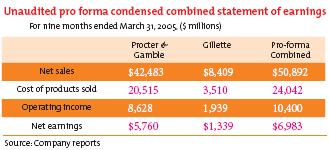 In the process, P&G seems to be indeed baying for UniLever’s blood in the battle for absolute dominance in the FMCG sector now.
The strategy is pretty straightforward; the future belongs to the company that has the maximum number of powerful brands in its portfolio. As companies shy away from in-house development of nouveau brands and products; acquisitions are the only logical route. While P&G of yore had 16 ‘billion dollar’ brands, Gillette added five more, resulting in a portfolio of 21 ‘billion dollar’ brands. Gillette’s brands include Mach3, Braun, Duracell and Oral-B. P&G, on the other hand, prides itself with brands like Ariel, Olay, Head & Shoulders and Tide. The acquisition is in line with P&G’s recent acquisitions of Clairol, a premium shampoo brand in 2001 and leading hair care brand, Wella, in 2003.
“This combination of two best-in-class consumer products companies, at a time when they are both operating from a position of strength, is a unique opportunity,” said A.G. Lafley, Chairman and Chief Executive of P&G. This acquisition also emphasised P&G’s desire towards being a lifestyle brand from just a consumer products company. The combined entity posted revenues of $17.25 billion (an increase of 21% year on year) for the quarter ending March 2006, compared to Unilever’s $12.33 billion. The deal would take time to unleash its full potential, as P&G attempts to integrate Gillette’s brands. But, perhaps it’s the “best a man can get” – for P&G!
For Complete IIPM Article, Click here
Source : IIPM Editorial, 2006
 In the process, P&G seems to be indeed baying for UniLever’s blood in the battle for absolute dominance in the FMCG sector now.
The strategy is pretty straightforward; the future belongs to the company that has the maximum number of powerful brands in its portfolio. As companies shy away from in-house development of nouveau brands and products; acquisitions are the only logical route. While P&G of yore had 16 ‘billion dollar’ brands, Gillette added five more, resulting in a portfolio of 21 ‘billion dollar’ brands. Gillette’s brands include Mach3, Braun, Duracell and Oral-B.
 P&G, on the other hand, prides itself with brands like Ariel, Olay, Head & Shoulders and Tide. The acquisition is in line with P&G’s recent acquisitions of Clairol, a premium shampoo brand in 2001 and leading hair care brand, Wella, in 2003.
“This combination of two best-in-class consumer products companies, at a time when they are both operating from a position of strength, is a unique opportunity,” said A.G. Lafley, Chairman and Chief Executive of P&G. This acquisition also emphasised P&G’s desire towards being a lifestyle brand from just a consumer products company. The combined entity posted revenues of $17.25 billion (an increase of 21% year on year) for the quarter ending March 2006, compared to Unilever’s $12.33 billion. The deal would take time to unleash its full potential, as P&G attempts to integrate Gillette’s brands. But, perhaps it’s the “best a man can get” – for P&G!
For Complete IIPM Article, Click here
Source : IIPM Editorial, 2006
For More IIPM Info, Visit here...
About IIPM ! IIPM Programmes ! IIPM Placement ! IIPM Alumni ! IIPM Alliances ! IIPM Ranking ! IIPM Director's Desk ! IIPM Dean's Message ! History of IIPM ! IIPM Mission !IIPM Libraries ! IIPM Cafeteria ! IIPM Academic Centres ! IIPM Wilton Park Reports ! IIPM Feedback ! IIPM Links ! IIPM Sitemap ! Contact IIPM !
Thursday, May 25, 2006
GOOGLE.COM – search it not; for it will search you out : IIPM

It’s literally transmogrified into a synonym for search; and it’s the world’s largest internet search company in the world. For today’s information hungry generation, Google provides the answer to all questions. It originated as a research project of Stanford Ph.D students Larry Page and Sergey Brin in 1996. It was answering around ten thousand search queries a day by the time the company was officially launched. By February 1999, Google was answering around 500,000 queries a day, and was fast moving up as one of the top Internet companies of the world. One of the few companies to survive the dotcom crash, Google steadily grew in ad revenues and further developed its search engine algorithms, adding features like Google Image search, Google News, Adsense and Google Catalog search….
Read Complete IIPM Article, Click on IIPM Article
Source :- IIPM Editorial, 2006
Read Complete IIPM Article, Click on IIPM Article
Source :- IIPM Editorial, 2006
For More IIPM Info, Please visit below :
IIPM Curriculum ! IIPM Project Based Learning ! IIPM GOTA ! IIPM Dual Specialisation ! IIPM Faculty ! IIPM GOP ! IIPM Campus Resources ! IIPM Campus Events ! IIPM Sports Club ! IIPM Support Services ! IIPM Campus ! IIPM Libraries !
IIPM Curriculum ! IIPM Project Based Learning ! IIPM GOTA ! IIPM Dual Specialisation ! IIPM Faculty ! IIPM GOP ! IIPM Campus Resources ! IIPM Campus Events ! IIPM Sports Club ! IIPM Support Services ! IIPM Campus ! IIPM Libraries !
Saturday, May 13, 2006
Two most important steps are to measure customer profitability & institutionalize customer centricity
B-SCHOOL INDIA
Finally, the company should institutionalize customer centricity. This is accomplished by making the customer segments the basic business units of the company; that is, organising by customer segment rather than by product, geography or function. Customer-centric innovation allows firms to offer increasingly tempting value propositions, helping them to avoid the trap of competing on price. The superior returns allow the customer-centric innovator to continually reinvest in the customer knowledge base. The result: A truly virtuous learning cycle and a never-ending source of competitive advantage….
Read Complete IIPM Article, Click on IIPM Article
Source :- IIPM Editorial, 2006
Read Complete IIPM Article, Click on IIPM Article
Source :- IIPM Editorial, 2006
Subscribe to:
Posts (Atom)